This is a classic example of interference effects in light waves. Two light rays pass through two slits, separated by a distance d and strike a screen a distance, L , from the slits, as in Fig. 22.10. If d < < L then the difference in path length r1 - r2 travelled by the two rays is approximately:
r1 - r2
where  dsin dsin   is approximately equal to the angle that the rays make relative to a perpendicular line joining the slits to the screen.If the rays were in phase when they passed through the slits, then the condition for constructive interference at the screen is: is approximately equal to the angle that the rays make relative to a perpendicular line joining the slits to the screen.If the rays were in phase when they passed through the slits, then the condition for constructive interference at the screen is:
dsin
whereas the condition for destructive interference at the screen is: = m ,m = ,m =  1, 2,... 1, 2,...
dsin
The points of constructive interference will appear as bright bands on the screen and the points of destructive interference will appear as dark bands. These dark and bright spots are called interference fringes. Note: = (m +  ) ,m = 1, 2,... ) ,m = 1, 2,...
|
2013년 1월 31일 목요일
이중슬릿

 brightspots
 darkspots
 y =
y = 

isentropic process 등엔트로피 과정
Example: The minimum pressure and temperature in an Otto cycle are 100 kPa and 27oC. The amount of heat added to the air per cycle is 1500 kJ/kg. Determine the pressure and temperatures at all salient points of the air standard Otto cycle. Also, calculate the specific work and the thermal efficiency of the cycle for a compression ratio of 8 : 1. [Take Cp/Cv = 1.4 and Cv = 0.72 kJ/kg K]
Solution: Given that :

P1 = 100 kPa
T1 = 27oC = 27 + 273 = 300 K
qs = 1500 kJ/kg
V1/V2 = r = 8
Cv = 0.72 kJ / kg K
Cp / Cv = 1.4
Analysis of process
Process (1-2): Rev. adiabatic compression
⇒ P1V1∏ = P2V2∏
P2/P1 = (V1/V2)∏
P2 = 100 X (8)1.4 = 1837.92 kPa
T2 / T1 = (V1/V2) ∏–1
⇒ T2 = 300 (8)0.4 = 689.22 K
Process (2-3): Constant volume heat supply
⇒ P2/T2 = P3/T3
Heat supplied; qs = Cv (T3 – T2)
⇒ 1500 = 0.72 (T3 – 689.22)
⇒ T3 = 2772.55 K
P3 = (P2 / T2).T3 = 2772.55 X (1837.92 / 689.22)
⇒ P3 = 7393.48 kPa
Process (3-4): Rev. adiabatic expansion
⇒ P3V3∏ = P4V4∏
⇒ P4 / P3 = (V3 / V4)∏ = (V2 / V1)∏
⇒ P4 = P3 (V2 / V1)∏ = 7393.48 (1/8)1.4 = 402.28 kPa
T4 / T3 = (P4 / P3)∏–1/∏ = (402.28 / 7393.48)0.4/1.4
T4 = T3 × (P4 / P3)∏–1/∏ = 2772.55 (402.28 / 7393.48)0.4/1.4
⇒ T4 = 1206.83 K
Heat rejected qR = Cv (T4 – T1)
= 0.72 (1206.83 – 300)
= 652.92 kJ/kg
Specific work output = wexpansion + wcompression
∫δw
From first law:
∫δw = ∫ δq =qs - qR
= 1500 – 652.92 = 847.08 kJ/kg
∴ ∏thermal = ∫δw/qs = 847.08/1500 = 0.5647 (or 56.48%)
Example : In an air standard Otto cycle, the compression ratio is 7 and the compression begins at 35oC, 0.1 MPa. The maximum temperature of the cycle is 1100oC. Find
(a) The temperature and pressure at the cordinal points of the cycle
(b) The heat supplied per kg of air
(c) The work done per kg of air
(d) The cycle efficiency
(e) The mean effective pressure of the cycle
Solution: Given that:
Compression ratio: r = 7
Inlet temperature, T1 = 35 + 273 = 308 K

Maximum temperature, t3 = 1100 + 273 = 1373 K
Process (1-2): Isentropic process
T2 / T1 = (V1 / V2)∏–1 = (P2 / P1)∏–1/∏
⇒ T2 = 308 (7)1.4–1 = 670.80 K
Also T3 / T4 = (V4 / V3)∏–1
⇒ T4 = T3 / r∏–1 = 1373 / (7)1.4–1
⇒ T4 = 630.42 K
And P2 / P1 = (V1/V2)∏
⇒ P2 = 0.1 X´ (7)1.4
⇒ P2 = 1.524 MPa
For Isochoric process (2-3)
P2 / T2 = P3 / T3
⇒ P3 = T3 / T2 X P2 = 1.524 X (1373 / 630.42) = 3.319 MPa
P3/P4 = (V1/V2)∏
⇒ P4 = 3.319 / (7)1.4 = 0.2177 MPa
∴ T1 = 308 K, P1 = 1 bar
T2 = 670.80 K, P2 = 15.24 bar
T3 = 1373 K, P3 = 33.19 bar
T4 = 630.42 K; P4 = 2.177 bar
(b) heat supplied per kg of air = Cv (T3 – T2)
= 0.718 (1373 – 670.80) = 504.18 kJ/kg
(c) Work done per kg of air = ∫δw = ∫δq = 2q3 + 4q1
⇒ ∫δw = Cv (T3 - T2) + Cv (T1 - T4) = Cv (T3 - T2) - Cv (T4 - T1)
= 0.718 (1373 – 670.80) – 0.718 (630.42 – 308) = 272.68 kJ/kg
(d) ∏cycle = ∫δw/qs = 272.68 / 504.18 X 100 = 54.08%
(e) m.e.p. = Wnet / V1 – V2 = 272.68 /V1 – V2
P1V1 = mRT1
V1 = 0.287 X 623 / 0.1 X 103 = 1.78 m3 / kg
V1/V2 = 7 or V2 = V1/7 = 1.78/7 = 0.254 m3 / kg
m.e.p. = 272.68 (kJ/kg) / (1.78 – 0.254) (m3/kg) = 178.72 kN/m2 = 1.79 bar

2013년 1월 30일 수요일
work 폴더 내의 모든 mp4파일의 확장자를 mp3로 바꾸는 펄 스크립트
#!/usr/local/bin/perl -w

use warnings;
use File::Copy qw(move);

opendir (DIR, "/work/");

@name = readdir(DIR);  # all names

@r_name = @name[0..$#name];
for (@r_name) {
   s/mp4/mp3/
}

print "@name\n";
print "@r_name\n";

for($i = 0; $i < $#name; $i++ )
{
#rename $name[$i], $r_name[$i];
move $name[$i], $r_name[$i] || die "Can't rename\n";
}

closedir(DIR);
2013년 1월 28일 월요일
화학평형 깁스에너지
quilibrium
Chemical equilibrium is a state in which there is no net change in the concentration of reactants and products because the forward and reverse reactions are occurring at the same rate and the Gibbs free energy value is at its minimum.The Gibbs free energy change of a reaction tells us what the concentration of reactants and products will be at equilibrium. For a general reaction of a moles of A, b moles of B and c moles of C combining to form n moles of N, m moles of M, and o moles of O...

If the reaction is not at equilibrium, it will proceed in the forward or reverse direction to the minimum value of the Gibbs free energy. At that point, there is no further change in the Gibbs free energy (
 G = 0) and the reaction is at equilibrium.
벤젠 엠오
B. MOLECULAR ORBITAL REPRESENTATION OF BENZENE (MO THEORY)
The bond angles of 120° in benzene suggests that C atoms are sp2 hybridised. An alternative representation therefore starts with a planar framework and considers overlap of the p orbitals (p electrons).
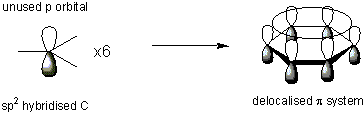
Mix n x p atomic orbitals
 np molecular orbitals!
Remember ethene? (p 26)
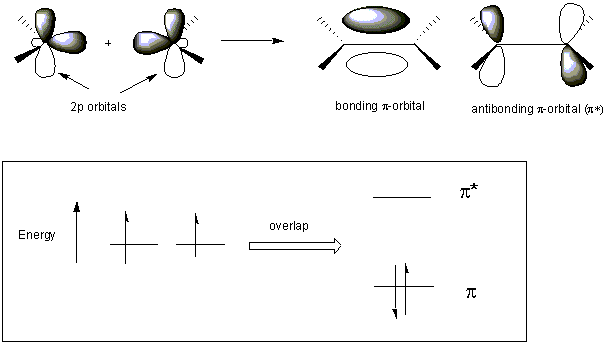

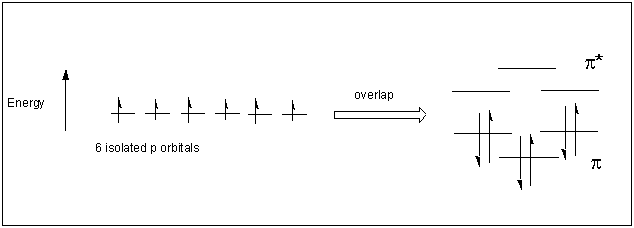
Each MO can accommodate 2 electrons, so for benzene we see all electrons are paired and occupy low energy MO’s (bonding MO’s). All bonding MO’s are filled. Benzene is therefore said to have a closed bonding shell of delocalised p electrons and this accounts in part for the stability of benzene.
이상기체 등온과정
등온 과정(等溫 過程)은 계의 온도 변화가 없는 열역학적 과정을 말한다.
 이 과정은 일반적으로 열저장소(열욕조)로 둘러싸인(혹은 열적으로 연결된) 계에서 일어나게 되며, 계의 열역학적 과정이 열저장소와 열교환을 통해 열저장소와 온도 평형을 이루기에 충분하도록 천천히 일어나게 된다. 등온 과정 이외에도 계의 주변과 열교환이 일어나지 않는 특별한 경우를 단열 과정이라 한다.(
 )
)
이상기체의 경우, 기체의 온도는 기체 내부에 존재하는 내부에너지에 의해 결정된다. 여기서 기체의 내부에너지란 볼츠만 분포에 의해 주어지는 기체 분자들의 운동에너지의 평균값을 말한다. 만약 이 내부에너지가 일정하다면 기체의 온도 또한 일정한 값을 가지게 된다. n을 기체의 몰수라 하고 일정한 값을 갖는다고 하자.

 이상기체의 등온선 그래프
그래프에서 나타나는 곡선은 등온선으로서 P-V(압력-부피) 그래프에서 온도가 같은 점들을 연결하면 쌍곡선과 같은 모양을 갖는다. 그리고 각각의 등온선들은 P축(세로축)과 V축(가로축)에서 점근하는 모양을 갖는다. 이 그래프는 이상기체 방정식에서 구할 수 있는 다음과 같은 공식과 일치하는 결과이다.
이상기체의 등온선 그래프
그래프에서 나타나는 곡선은 등온선으로서 P-V(압력-부피) 그래프에서 온도가 같은 점들을 연결하면 쌍곡선과 같은 모양을 갖는다. 그리고 각각의 등온선들은 P축(세로축)과 V축(가로축)에서 점근하는 모양을 갖는다. 이 그래프는 이상기체 방정식에서 구할 수 있는 다음과 같은 공식과 일치하는 결과이다.
 노란 영역은 일을 뜻함
등온과정에서 순간시간에 대한 순간적인 일은 다음과 같은 식으로 나타낼 수 있다.
노란 영역은 일을 뜻함
등온과정에서 순간시간에 대한 순간적인 일은 다음과 같은 식으로 나타낼 수 있다.
 카르노 기관의 온도-엔트로피 그래프 ; 가로선이 등온과정을 나타냄
등온과정은 여러 종류의 계에서 나타날 수 있다. 복잡한 구조를 가지는 기계나 심지어 살아있는 세포에서도 나타난다. 일부 열기관의 경우 등온과정이라 가정하고, 카르노 기관으로 근사시킬 수 있다.
카르노 기관의 온도-엔트로피 그래프 ; 가로선이 등온과정을 나타냄
등온과정은 여러 종류의 계에서 나타날 수 있다. 복잡한 구조를 가지는 기계나 심지어 살아있는 세포에서도 나타난다. 일부 열기관의 경우 등온과정이라 가정하고, 카르노 기관으로 근사시킬 수 있다.
이 과정은 일반적으로 열저장소(열욕조)로 둘러싸인(혹은 열적으로 연결된) 계에서 일어나게 되며, 계의 열역학적 과정이 열저장소와 열교환을 통해 열저장소와 온도 평형을 이루기에 충분하도록 천천히 일어나게 된다. 등온 과정 이외에도 계의 주변과 열교환이 일어나지 않는 특별한 경우를 단열 과정이라 한다.()이상기체의 경우, 기체의 온도는 기체 내부에 존재하는 내부에너지에 의해 결정된다. 여기서 기체의 내부에너지란 볼츠만 분포에 의해 주어지는 기체 분자들의 운동에너지의 평균값을 말한다. 만약 이 내부에너지가 일정하다면 기체의 온도 또한 일정한 값을 가지게 된다. n을 기체의 몰수라 하고 일정한 값을 갖는다고 하자.





2013년 1월 27일 일요일
hi socket
#ifndef UNICODE #define UNICODE #endif #define WIN32_LEAN_AND_MEAN #include#include #include // Link with ws2_32.lib #pragma comment(lib, "Ws2_32.lib") #define DEFAULT_BUFLEN 512 #define DEFAULT_PORT 80 int main() { //---------------------- // Declare and initialize variables. int iResult; WSADATA wsaData; SOCKET ConnectSocket = INVALID_SOCKET; struct sockaddr_in clientService; int recvbuflen = DEFAULT_BUFLEN; char *sendbuf = "GET / HTTP/1.1\r\n\r\n"; char recvbuf[DEFAULT_BUFLEN] = ""; //---------------------- // Initialize Winsock iResult = WSAStartup(MAKEWORD(2,2), &wsaData); if (iResult != NO_ERROR) { wprintf(L"WSAStartup failed with error: %d\n", iResult); return 1; } //---------------------- // Create a SOCKET for connecting to server ConnectSocket = socket(AF_INET, SOCK_STREAM, IPPROTO_TCP); if (ConnectSocket == INVALID_SOCKET) { wprintf(L"socket failed with error: %ld\n", WSAGetLastError()); WSACleanup(); return 1; } //---------------------- // The sockaddr_in structure specifies the address family, // IP address, and port of the server to be connected to. clientService.sin_family = AF_INET; clientService.sin_addr.s_addr = inet_addr( "180.70.134.19" ); clientService.sin_port = htons( DEFAULT_PORT ); //---------------------- // Connect to server. iResult = connect( ConnectSocket, (SOCKADDR*) &clientService, sizeof(clientService) ); if (iResult == SOCKET_ERROR) { wprintf(L"connect failed with error: %d\n", WSAGetLastError() ); closesocket(ConnectSocket); WSACleanup(); return 1; } //---------------------- // Send an initial buffer iResult = send( ConnectSocket, sendbuf, (int)strlen(sendbuf), 0 ); if (iResult == SOCKET_ERROR) { wprintf(L"send failed with error: %d\n", WSAGetLastError()); closesocket(ConnectSocket); WSACleanup(); return 1; } printf("Bytes Sent: %d\n", iResult); // Receive until the peer closes the connection do { iResult = recv(ConnectSocket, recvbuf, recvbuflen, 0); if ( iResult > 0 ) wprintf(L"Bytes received: %d\n", iResult); else if ( iResult == 0 ) wprintf(L"Connection closed\n"); else wprintf(L"recv failed with error: %d\n", WSAGetLastError()); } while( iResult > 0 ); // close the socket iResult = closesocket(ConnectSocket); if (iResult == SOCKET_ERROR) { wprintf(L"close failed with error: %d\n", WSAGetLastError()); WSACleanup(); return 1; } WSACleanup(); return 0; }
low spin complexes
Figure 9 d orbital splitting in an octahedral complex

The electrons can actually be distributed in two ways among the two sets of orbitals for complexes with 4,5,6 or 7 d electrons: occupying the lowest orbitals (low spin) or spread over both sets of orbitals (high spin). As you can see in Figure 9 (a) and (b) we have two different configurations for iron(II), which has 6 d electrons - (a) has no unpaired electrons and is thus non-magnetic and is known as low spin; (b) has four unpaired electrons and is magnetic and is known as high spin.
The magnitude of the energy gap between the two levels, , which is known as the 'ligand field splitting', determines whether we get the high spin or low spin form. If is small than the lowest energy state is when electrons are distributed over both levels and we get high spin complexes. If is large then the lowest energy state is when electrons occupy the lowest level preferentially and low spin complexes result.
The size of the splitting, , for a given metal depends on its oxidation state (charge) and on the nature of the ligand bonded to the central metal. is larger for +3 than for +2 ions, and increases as the strength of bonding between the ligand and metal increases. Thus water is a weak ligand and produces a small ligand field splitting and (usually) high spin complexes. Cyanide, on the other hand, bonds very strongly to transition metal ions with a mixture of å and ã bonding and usually produces low spin complexes (see Figure 9). Common ligands can be arranged in order of the splitting they produce and this series is known as the spectrochemical series (Table 1).
The magnitude of the energy gap between the two levels, , which is known as the 'ligand field splitting', determines whether we get the high spin or low spin form. If is small than the lowest energy state is when electrons are distributed over both levels and we get high spin complexes. If is large then the lowest energy state is when electrons occupy the lowest level preferentially and low spin complexes result.
The size of the splitting, , for a given metal depends on its oxidation state (charge) and on the nature of the ligand bonded to the central metal. is larger for +3 than for +2 ions, and increases as the strength of bonding between the ligand and metal increases. Thus water is a weak ligand and produces a small ligand field splitting and (usually) high spin complexes. Cyanide, on the other hand, bonds very strongly to transition metal ions with a mixture of å and ã bonding and usually produces low spin complexes (see Figure 9). Common ligands can be arranged in order of the splitting they produce and this series is known as the spectrochemical series (Table 1).
Calculating solubilities from solubility products
Calculating solubilities from solubility products
Reversing the sums we have been doing isn't difficult as long as you know how to start. We will take the magnesium hydroxide example as above, but this time start from the solubility product and work back to the solubility.
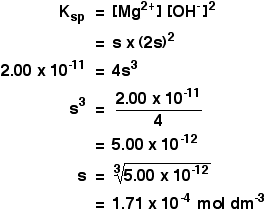
If the solubility product of magnesium hydroxide is 2.00 x 10⁻¹¹mol3 dm-9 at 298 K, calculate its solubility in mol dm-3 at that temperature.


The trick this time is to give the unknown solubility a symbol like x or s. I'm going to choose s, because an x looks too much like a multiplication sign.
If the concentration of dissolved magnesium hydroxide is s mol dm-3, then:
[Mg2+] = s mol dm-3[OH-] = 2s mol dm-3
Put these values into the solubility product expression, and do the sum.
피드 구독하기:
글 (Atom)