생성자를 추가했다. 객체 생성시 a = 8로 b=10으로 초기화 된다.
----------------------
class CS{
public:
int a, b;
CS(){
a = 8;
b = 10;
}
void swap()
{
int temp;
temp = a;
a=b;
b =temp;
}
};
-----------
#include <stdio.h>
#include "CS3.h"
int main()
{
CS cs1;
cs1.swap();
printf("a=%d, b=%d\n", cs1.a, cs1.b);
return 0;
}
2012년 12월 31일 월요일

2012년 12월 30일 일요일
[c++/class] 스왑 객체 버전
클래스에 멤버변수를 선언하고 객체에서 사용했다. 좀 더 완성된 형태의 클래스
--------
class CS{
public:
int a, b;
void swap()
{
int temp;
temp = a;
a=b;
b =temp;
}
};
--------
#include <stdio.h>
#include "CS3.h"
int main()
{
CS cs1;
cs1.a = 3;
cs1.b = 5;
cs1.swap();
printf("a=%d, b=%d\n", cs1.a, cs1.b);
return 0;
}
--------
class CS{
public:
int a, b;
void swap()
{
int temp;
temp = a;
a=b;
b =temp;
}
};
--------
#include <stdio.h>
#include "CS3.h"
int main()
{
CS cs1;
cs1.a = 3;
cs1.b = 5;
cs1.swap();
printf("a=%d, b=%d\n", cs1.a, cs1.b);
return 0;
}
ionization energy of CO
The ionization energy of CO is greater than that of NO.
Explain this difference based on the elctron configuration of these two
molecules
Answers (1)



The HOMO of NO is an anti-bonding molecular orbital, whereas the HOMO of CO is a bonding molecular orbital. The unpaired electron in the antibonding HOMO of NO is higher in energy than those in the bonding HOMO of CO. Therefore the NO molecule is easier to ionize than CO.
Carbocation
<img
height="1" width="1" border="0"
src="http://googleads.g.doubleclick.net/pagead/viewthroughconversion/1011444082/?frame=0&random=1356842751841&cv=7&fst=1356842751841&num=1&fmt=1&label=DQQOCM6UqQMQ8tKl4gM&guid=ON&u_h=768&u_w=1024&u_ah=738&u_aw=1024&u_cd=24&u_his=1&u_tz=540&u_java=false&u_nplug=4&u_nmime=13&ref=http%3A//www.google.co.kr/imgres%3Fhl%3Dko%26newwindow%3D1%26tbo%3Dd%26biw%3D1024%26bih%3D630%26tbm%3Disch%26tbnid%3DK9ATmgWsfMZAIM%3A%26imgrefurl%3Dhttp%3A//chemistry.tutorvista.com/organic-chemistry/carbocation.html%26docid%3DrkTy3NkN_PV4YM%26imgurl%3Dhttp%3A//images.tutorvista.com/cms/images/75/Untit&url=http%3A//chemistry.tutorvista.com/organic-chemistry/carbocation.html&frm=0"
/>
Top
Carbocation
The tetravalancy of carbon proves that carbon
forms total four bonds to get octet. These four bonds can arrange in
different ways like tetrahedral, trigonal planer or linear manner in
three dimensional space.
However there are some other possible species, in which carbon atom does not follow tetravalancy and forms less than four bonds. These species generally forms as an intermediate in between reaction.
Some of these species are stable while some are highly unstable and decompose readily to form stable compounds. These species are as follows.
- Carbocations
- Carbanions
- Free radicals
- Carbenes
An intermediate which carry positive
charge on carbon atom is called as carbocation. Initially it termed as
carbonium ion and after 1902 George Olah purposed name carbonium ion for CH5+ ion in which carbon shows five valences with positive charge.
He gave the general term carbocation in which carbon carry positive charge which later accepted by IUPAC. Depends upon the bonding of carbon contains positive charge; carbocation can be various types.
1. Alkyl carbocation: It can be four types
The cationic carbon atom carry positive charge in alkyl carbocation is sp2 hybridized with planer trigonal structure with three bonds. The empty unhybridised p-orbital bearing positive charge and it can accept electrons. Hence carbocation acts as good electrophiles.
 The type of alkyl carbocation depends upon the type of carbon atom bearing positive charge.
 Those carbocation in which the cationic carbon
attached to one other alkyl group is called as primary carbocation.
Hence the ionized carbon atom is a primary carbon atom. Alkyl group is a
group containing one or more carbon atom in chain which can be
branched.
For example; Methyl group (CH3-), ethyl group (CH3CH2-), Isopropyl group ((CH3)2CH-. The general representation of alkyl group is –R. By using some of the alkyl groups, let’s make primary carbocations.
Hence
does not matter how many carbon atoms present in a primary carbocation,
the most important point is the bonding of cationic carbon atom which
must bonded with one more alkyl group only and the general formula of
primary carbocation will be R-CH2+.
Since there is only one alkyl group attached on primary carbon atom, hence primary carbocation is very less crowded and can easily accept electrons from nucleophile in nucleophilic substitution reactions. Because of planer trigonal nature and less steric hindrance in primary carbocation decided the stereochemistry of nucleophilic product of substitution reaction proceeds through the formation of carbocation as an intermediate.
Due to less steric hindrance in primary carbocation, the nucleophilic substitution reactions of haloalkane proceed through bimolecular nucleophilic substitution mechanism (SN2) through the formation of an unstable transition state. Since for the formation of transition state the coming nucleophile has to attack from the back side of leaving group, the reaction proceeds through the inversion of configuration also termed as Walden inversion.
If the cationic carbon atom attached with three different or same alkyl groups, it termed as tertiary carbocation. The general formula of tertiary carbocation is R3-C+
There are three same or different alkyl group
attached on positively charged carbon in tertiary carbocation, hence the
coming nucleophile feels high steric hindrance for the formation of
transition
state during nucleophilic substitution reaction.
Hence instead of making transition state, tertiary halo-compounds form carbocation as an intermediates and proceeds through unimolecular nucleophilic reaction (SN1). Since there is the equal possibility for the nucleophile to attack on cationic carbon atom, hence products are racemic mixture and optically inactive.
There are several kinds of organic reaction in which carbocation form as an intermediate. Stable carbocation can be easily forms in aqueous solution and even in some cases in solid state also. Because of complete positive charge on carbon atom in carbocation, they can be easily solvated in polar solvent. Generally carbocation exits as ion pair in solution with oppositely charged ion also known as counter ion in non-polar solvent.
The order of stability of alkyl carbocations is
The stability of carbocation can be explained by using two effects.
The induction of polarity in a molecule due to the delocalization of pi electrons or lain pair of electrons in a molecule is called as resonance or mesomeric effect. This effect is also known as mesomeric effect. If in a carbocation, the positive charge located in the conjugation with double bond, it get delocalized over molecule and get stability due to resonance and delocalization of positive charge over more than one atom.
For example, vinyl carbocation shows two resonating structures and get stable.
CH2=CH + ↔ +CH2-CH-
Similarly allylic carbocation shows two resonating structures in which positive charge delocalized over three carbon atom and it becomes more stable than vinylic carbocation.

As
the number of resonating structures increases, the stability of
carbocation increases. Just like allylic carbocation, benzylic
carbocation is also stable due to resonance effect. In this carbocation;
the positive charge delocalized over aromatic ring and stabilized the
carbocation.

Because of resonance effect of three phenyl group in triphenyl carbocation, Ph3C+ and tropylium ion are stable carbocation.

The stability of carbocation can be explained by using the concept of hyper conjugation. It is the delocalization of the sigma bonded electrons generally C–H or C–C) with an adjacent empty unhybridised p-orbital or anti-bonding π orbital or filled π orbital which increases the stability of the molecule.
 Just
like inductive effect, hyper conjugation also delocalized the positive
charge of cationic carbon atom and stable the carbocation. Since hyper
conjugation involve alpha hydrogen atom of C-H bond, hence as the number
of alpha hydrogen atoms increases the canonical forms increases and
stability of carbocation increases.
In tertiary carbocation like tert-butyl carbocation, there are nine alpha hydrogen atoms, hence ten canonical forms are possible and tertiary carbocation is most stable compare to secondary carbocation like 2-propyl with six alpha hydrogen atom and seven canonical forms.
On the other hand, primary carbocation like ethyl carbocation contains only three alpha hydrogen atom to form canonical forms and least stable. Hence as the number of alkyl substituents increases on cationic carbon atom, the more sigma bonds for hyper conjugation and stability increases.

The stability of the carbocation in terms of energy. The stability of any species is directly related to the energy level of that species. More energetic species is less stable. As we move from tertiary to secondary to primary carbocation, energy of carbocations increases and stability decreases. Hence more energy required to make a primary carbocation than a secondary one.
 If
in any organic reaction, there is an option to make secondary or
primary carbocation, reaction will proceeds through the formation of
secondary carbocation as less energy required to form this and it is
more stable than primary one.
In some of the organic reactions which completed through the formation of carbocation show carbocation rearrangements. It depends on the type f carbocation formed during the reaction; a carbocation rearrange in such a way to form a more stable carbocation. Usually the bonding electrons of a carbocation shift between adjacent atoms and form a more stable carbocation.
For example, a secondary carbocation can be rearranged to from a primary carbocation as a secondary carbocation is more stable than the primary carbocation.
This carbocation rearrangement can be two types of rearrangements.
1. Shift of an alkyl group (1,2-alkyl shift): In this type of rearrangement an alkyl group bonded at alpha carbon atom of primary carbocation shifted at cationic carbon and positive charge shifted at alpha carbon atom results the formation of secondary carbocation.

2.
Shift of a hydrogen atom (1,2-hydride shift): In place of alkyl group,
this type of rearrangement involve the shifting of hydride group (H-)
from 2 to 1 position.

The
1,2-hydride shift in primary carbocation forms a tertiary carbocation
however the 1,2- alkyl shift forms a secondary carbocation. The tertiary
carbocation is more stable than a secondary carbocation, hence
the1,2-hydride shift is favoured over 1,2-alkyl shift.
Both carbocation rearrangements involve the migration of C–H or C–C bond adjacent to a cationic carbon atom. Vinylic carbocation does not rearrangements to more stable allylic carbocation due to orbital alignment restrictions during the rearrangement.


He gave the general term carbocation in which carbon carry positive charge which later accepted by IUPAC. Depends upon the bonding of carbon contains positive charge; carbocation can be various types.
1. Alkyl carbocation: It can be four types
- Primary carbocation: R-CH2+
- Secondary carbocation(R)2CH+
- Tertiary carbocation: (R)3C+
- Vinyl carbocation: CH2=CH+
- Allyl carbocation : CH2=CH-CH2+
- Phenyl carbocation: C6H5+
- Benzyl carbocation: C6H5CH2+
- Triphenyl carbocation: ( C6H5)3C+
The cationic carbon atom carry positive charge in alkyl carbocation is sp2 hybridized with planer trigonal structure with three bonds. The empty unhybridised p-orbital bearing positive charge and it can accept electrons. Hence carbocation acts as good electrophiles.
The
geometry of carbocation is an important factor in the consideration of
the stereochemistry of reactions. Because of planer trigonal geometry
the coming nucleophile can attack from both direction to form product in
nucleophilic substation reactions, hence form racemic mixture of
substituted product.
For example; Methyl group (CH3-), ethyl group (CH3CH2-), Isopropyl group ((CH3)2CH-. The general representation of alkyl group is –R. By using some of the alkyl groups, let’s make primary carbocations.
| Alkyl group | Primary carbocation | Name of Primary carbocation |
| Methyl group (CH3-) | CH3 CH2+ | Ethyl carbocation |
| Ethyl group (CH3CH2-) | CH3CH2 CH2+ | Propyl carbocation |
| Isopropyl group ((CH3)2CH- | (CH3)2CHCH2+ | Isobutyl carbocation |
| Propyl group (CH3CH2CH2-) | CH3CH2CH2 CH2+ | Butyl carbocation |
| Butyl group(CH3CH2CH2CH2-) | CH3CH2 CH2CH2 CH2+ | Pentyl carbocation |
Since there is only one alkyl group attached on primary carbon atom, hence primary carbocation is very less crowded and can easily accept electrons from nucleophile in nucleophilic substitution reactions. Because of planer trigonal nature and less steric hindrance in primary carbocation decided the stereochemistry of nucleophilic product of substitution reaction proceeds through the formation of carbocation as an intermediate.
Due to less steric hindrance in primary carbocation, the nucleophilic substitution reactions of haloalkane proceed through bimolecular nucleophilic substitution mechanism (SN2) through the formation of an unstable transition state. Since for the formation of transition state the coming nucleophile has to attack from the back side of leaving group, the reaction proceeds through the inversion of configuration also termed as Walden inversion.
If the cationic carbon atom attached with three different or same alkyl groups, it termed as tertiary carbocation. The general formula of tertiary carbocation is R3-C+
Some common examples of tertiary carbocations are as follows.
| S.No | Tertiary carbocation | Name |
| 1 |
 |
2-Methylprop-2-yle carbocation or tertiary butyl carbocation |
| 2 |  |
2-Methylbut-2-yl carbocation |
| 3 |  |
3-Methylhex-3-yle carbocation |
state during nucleophilic substitution reaction.
Hence instead of making transition state, tertiary halo-compounds form carbocation as an intermediates and proceeds through unimolecular nucleophilic reaction (SN1). Since there is the equal possibility for the nucleophile to attack on cationic carbon atom, hence products are racemic mixture and optically inactive.
There are several kinds of organic reaction in which carbocation form as an intermediate. Stable carbocation can be easily forms in aqueous solution and even in some cases in solid state also. Because of complete positive charge on carbon atom in carbocation, they can be easily solvated in polar solvent. Generally carbocation exits as ion pair in solution with oppositely charged ion also known as counter ion in non-polar solvent.
The order of stability of alkyl carbocations is
Order of Carbocation Stability
Methyl carbocation (CH3(+)) < Primary carbocation (CH3CH2
(+) ) < Secondary carbocation ((CH3)2CH(+)) ≈ Allylic carbocation(CH2=CH-CH2(+))<Benzyl carbocation(C6H5CH2(+)) ≈ Trimethyl carbocation((CH3)3C(+)) < Triphenyl carbocation(Ph3C+ )
The stability of carbocation can be explained by using two effects.
- Inductive effect
- Resonance effect
- Hyperconjugation
Inductive effect
- The induction of polarity due to slight shifting of sigma electrons because of the
- presence of substituent at the end of parent carbon chain is called as induction effect.
- If any group attracted the sigma bonded electron it imparts negative inductive effect like halogen group while groups with positive inductive effect repel sigma bonded electrons like any alkyl
- group. Because of this shifting of sigma electrons, the partial positive and negative charge produced and molecule becomes polar in nature. This effect is better known as field effect.
- In case of carbocations; any group which can decreases the positive charge of cationic carbon atom will increase the stability of carbocation. As electron donating group increases the electron density on positively charged carbon atom and reduces the net charge on carbon atom. Hence as the number of group imparts positive inductive effect increases on cationic carbon atom, the stability of carbocation increases. That is the reason why tertiary carbocations are more
- stable then secondary than primary and methyl carbocation.
Resonance effect
The induction of polarity in a molecule due to the delocalization of pi electrons or lain pair of electrons in a molecule is called as resonance or mesomeric effect. This effect is also known as mesomeric effect. If in a carbocation, the positive charge located in the conjugation with double bond, it get delocalized over molecule and get stability due to resonance and delocalization of positive charge over more than one atom.
For example, vinyl carbocation shows two resonating structures and get stable.
CH2=CH + ↔ +CH2-CH-
Similarly allylic carbocation shows two resonating structures in which positive charge delocalized over three carbon atom and it becomes more stable than vinylic carbocation.
CH2=CH-CH2+ ↔ +CH2-CH=CH2
Hyperconjugation
The stability of carbocation can be explained by using the concept of hyper conjugation. It is the delocalization of the sigma bonded electrons generally C–H or C–C) with an adjacent empty unhybridised p-orbital or anti-bonding π orbital or filled π orbital which increases the stability of the molecule.
In tertiary carbocation like tert-butyl carbocation, there are nine alpha hydrogen atoms, hence ten canonical forms are possible and tertiary carbocation is most stable compare to secondary carbocation like 2-propyl with six alpha hydrogen atom and seven canonical forms.
On the other hand, primary carbocation like ethyl carbocation contains only three alpha hydrogen atom to form canonical forms and least stable. Hence as the number of alkyl substituents increases on cationic carbon atom, the more sigma bonds for hyper conjugation and stability increases.
The stability of the carbocation in terms of energy. The stability of any species is directly related to the energy level of that species. More energetic species is less stable. As we move from tertiary to secondary to primary carbocation, energy of carbocations increases and stability decreases. Hence more energy required to make a primary carbocation than a secondary one.
In some of the organic reactions which completed through the formation of carbocation show carbocation rearrangements. It depends on the type f carbocation formed during the reaction; a carbocation rearrange in such a way to form a more stable carbocation. Usually the bonding electrons of a carbocation shift between adjacent atoms and form a more stable carbocation.
For example, a secondary carbocation can be rearranged to from a primary carbocation as a secondary carbocation is more stable than the primary carbocation.
This carbocation rearrangement can be two types of rearrangements.
1. Shift of an alkyl group (1,2-alkyl shift): In this type of rearrangement an alkyl group bonded at alpha carbon atom of primary carbocation shifted at cationic carbon and positive charge shifted at alpha carbon atom results the formation of secondary carbocation.
Both carbocation rearrangements involve the migration of C–H or C–C bond adjacent to a cationic carbon atom. Vinylic carbocation does not rearrangements to more stable allylic carbocation due to orbital alignment restrictions during the rearrangement.
Some
rearrangements lead to the formation of more stable ring through
1,2-alkyl shift. For example, the formation of more stable secondary
carbocation drives the conversion of primary to secondary carbocation
through the increasing in the ring size.
Reducing Reagents
Reducing Reagents
| Reagent | Preferred Solvents | Functions Reduced | Reaction Work-up |
|---|---|---|---|
| Sodium Borohydride NaBH4 | ethanol; aqueous ethanol 15% NaOH; diglyme avoid strong acids | aldehydes to 1º-alcohols ketones to 2º-alcohols 1,2-reduction of enones is favored by CeCl3 inert to most other functions | 1) simple neutralization 2) extraction of product |
| Lithium Aluminum Hydride (LAH) LiAlH4 | ether; THF avoid alcohols and amines avoid halogenated compounds avoid strong acids | aldehydes to 1º-alcohols ketones to 2º-alcohols carboxylic acids to 1º-alcohols esters to alcohols epoxides to alcohols nitriles & amides to amines halides & tosylates to alkanes most functions react | 1) careful addition of water 2) dissolve aluminum salts 3) extraction of product |
| Lithium tri t-Butoxyaluminohydride LiAlH(Ot-C4H9)3 | ether; THF avoid alcohols and amines avoid halogenated compounds avoid strong acids | fast: acid chlorides to aldehydes (at -78 ºC) 3º-amides to aldehydes (at -78 ºC) nitriles to aldehydes (at -78 ºC) slower: aldehydes to 1º-alcohols ketones to 2º-alcohols |
1) careful addition of water 2) dissolve aluminum salts 3) extraction of product |
| Diisobutylaluminum Hydride AlH[CH2CH(CH3)2]2 | THF; toluene avoid alcohols and amines avoid halogenated compounds avoid strong acids | fast: acid chlorides to aldehydes (at -78 ºC) 3º-amides to aldehydes (at -78 ºC) nitriles to aldehydes (at -78 ºC) slower: aldehydes to 1º-alcohols ketones to 2º-alcohols |
1) careful addition of water 2) dissolve aluminum salts 3) extraction of product |
| Diborane B2H6 = 2 BH3 | ether; THF sulfide complex in CH2Cl2 complexes with amines avoid alkenes & alkynes | carboxylic acids to 1º-alcohols aldehydes to 1º-alcohols ketones to 2º-alcohols nitriles to amines esters & epoxides slowly reduced | 1) dilute acid or H2O2 2) extraction of product |
| Hydrogen & Catalyst H2 & Pt, or Pd, or Ru, or Ni Modified (poisoned) Catalyst | alcohols, ethers, hydrocarbons or carboxylic acids | alkenes & alkynes to alkanes (fast) nitro groups to amines (fast) imines to amines (fast) aldehydes & ketones to alcohols (slow) nitriles to amines (slow) may remove benzylic groups alkynes to alkenes acyl chlorides to aldehydes |
filter to remove catalyst |
| Reactive Metals Na, or Li, or K Mg or Al or Zn or Fe | liq. ammonia & ether co-solvents or alcohols or amines water, alcohols, acetic acid or aqueous mineral acid | ketones to 2º-alcohols alkynes to alkenes conjugated π-systems (e.g. aromatic rings, dienes & enones) cleaves C-X and benzylic groups cleaves activated substituents nitro groups to amines C=O (aldehyde/ketone) to CH2 |
1) quench with NH4Cl 2) extract product extract product from salts |
결정장 갈라짐 에너지


7. 결정장 이론
∙ 결정장 이론을 이용하여 착화합물의 색깔과 자기성을 설명하고 예측할 수 있다.
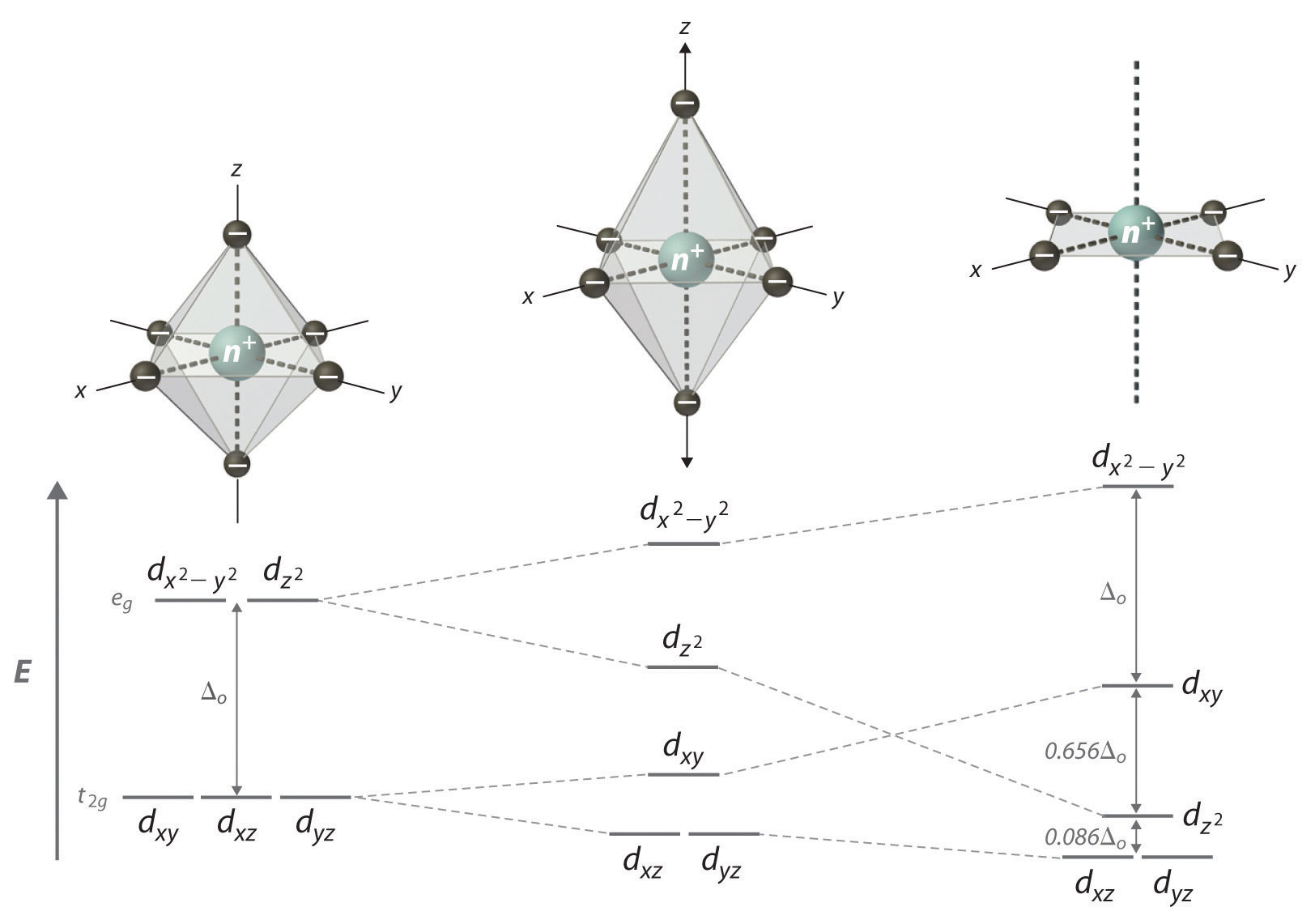
∙ 착이온 형성시 금속의 d오비탈의 에너지는 결정장 갈라짐에너지 Δ만큼 갈라진다.


<착이온의 결정장 형태>
|
정팔면체
|
정사면체
|
평면사각
|
|
━ ━ eg
━ ━ ━ t2g
|
━ ━ ━
━ ━
|
━
━
━
━ ━
|

∙ Δ는 리간드의 분광화학적 계열에 따라 증가한다.
|
I-< Br- < Cl- < F -< OH- < H2O < NH3 < en < CN-, CO
(약한장 리간드) (강한장 리간드)
|
∙ 착물은 Δ값이 클수록 짧은 파장의 빛을 흡수한다.
∙ 팔면체 착물에서 금속이온이 강한장 리간드와 배위되면 낮은 스핀 착물을 형성한다.
∙ 팔면체 착물에서 금속이온이 약한장 리간드와 배위되면 높은 스핀 착물을 형성한다.
∙ 몇몇 이온은 사면체 착물을 형성할 수 있다.
∙ 정사면체 착물의 Δ는 팔면체 착물의 Δ보다 작다.

∙ 정사면체 착물은 항상 높은 스핀 착물이다.
∙ 몇몇 이온은 평면 사각 착물을 형성할 수 있다.
∙ 평면사각 착물은 거의 대부분 낮은 스핀 착물이다.
<사면체와 평면 사각 착물의 종류>
|
정사면체
|
평면사각
|
|
[CuCl4]2-
|
[Cu(NH3)4]2+
|
|
[NiCl4]2-
|
[Cu(CN)4]2-
|
|
[Zn(NH3)4]2+
|
[Ni(CN)4]2-
|
|
[Co(NH3)4]2+
|
[PtCl4]2-
|
|
|
[PdCl4]2-
|
|
|
[PtCl2(NH3)2]
|


Tetrahedral (Δt) Transition-Metal Complexes
| Octahedral Complexes | Δo(cm−1) | Octahedral Complexes | Δo (cm−1) | Tetrahedral Complexes | Δt (cm−1) |
|---|---|---|---|---|---|
| [Ti(H2O)6]3+ | 20,300 | [Fe(CN)6]4− | 32,800 | VCl4 | 9010 |
| [V(H2O)6]2+ | 12,600 | [Fe(CN)6]3− | 35,000 | [CoCl4]2− | 3300 |
| [V(H2O)6]3+ | 18,900 | [CoF6]3− | 13,000 | [CoBr4]2− | 2900 |
| [CrCl6]3− | 13,000 | [Co(H2O)6]2+ | 9300 | [CoI4]2− | 2700 |
| [Cr(H2O)6]2+ | 13,900 | [Co(H2O)6]3+ | 27,000 | ||
| [Cr(H2O)6]3+ | 17,400 | [Co(NH3)6]3+ | 22,900 | ||
| [Cr(NH3)6]3+ | 21,500 | [Co(CN)6]3− | 34,800 | ||
| [Cr(CN)6]3− | 26,600 | [Ni(H2O)6]2+ | 8500 | ||
| Cr(CO)6 | 34,150 | [Ni(NH3)6]2+ | 10,800 | ||
| [MnCl6]4− | 7500 | [RhCl6]3− | 20,400 | ||
| [Mn(H2O)6]2+ | 8500 | [Rh(H2O)6]3+ | 27,000 | ||
| [MnCl6]3− | 20,000 | [Rh(NH3)6]3+ | 34,000 | ||
| [Mn(H2O)6]3+ | 21,000 | [Rh(CN)6]3− | 45,500 | ||
| [Fe(H2O)6]2+ | 10,400 | [IrCl6]3− | 25,000 | ||
| [Fe(H2O)6]3+ | 14,300 | [Ir(NH3)6]3+ | 41,000 | ||
|
*Energies obtained by spectroscopic measurements are often given in units of wave numbers (cm−1); the wave number is the reciprocal of the wavelength of the corresponding electromagnetic radiation expressed in centimeters: 1 cm−1 = 11.96 J/mol. | |||||
Source of data: Duward F. Shriver, Peter W. Atkins, and Cooper H. Langford, Inorganic Chemistry, 2nd ed. (New York: W. H. Freeman and Company, 1994).
| FeII | FeIII | CoII | CuII | AlIII | CrIII | |
|---|---|---|---|---|---|---|
| Hydrated Ion | [Fe(H2O)6]2+ Pale green Soln |
[Fe(H2O)6]3+ Yellow/brown Soln |
[Co(H2O)6]2+ Pink Soln |
[Cu(H2O)6]2+ Blue Soln |
[Al(H2O)6]3+ Colourless Soln |
[Cr(H2O)6]3+ Green Soln |
| OH−, dilute | [Fe(H2O)4(OH)2] Dark green Ppt |
[Fe(H2O)3(OH)3] Brown Ppt |
[Co(H2O)4(OH)2] Blue/green Ppt |
[Cu(H2O)4(OH)2] Blue Ppt |
[Al(H2O)3(OH)3] White Ppt |
[Cr(H2O)3(OH)3] Green Ppt |
| OH−, concentrated | [Fe(H2O)4(OH)2] Dark green Ppt |
[Fe(H2O)3(OH)3] Brown Ppt |
[Co(H2O)4(OH)2] Blue/green Ppt |
[Cu(H2O)4(OH)2] Blue Ppt |
[Al(OH)4]− Colourless Soln |
[Cr(OH)6]3− Green Soln |
| NH3, dilute | [Fe(H2O)4(OH)2] Dark green Ppt |
[Fe(H2O)3(OH)3] Brown Ppt |
[Co(H2O)4(OH)2] Blue/green Ppt |
[Cu(H2O)4(OH)2] Blue Ppt |
[Al(H2O)3(OH)3] White Ppt |
[Cr(H2O)3(OH)3] Green Ppt |
| NH3, concentrated | [Fe(H2O)4(OH)2] Dark green Ppt |
[Fe(H2O)3(OH)3] Brown Ppt |
[Co(NH3)6]2+ Straw coloured Soln |
[Cu(NH3)4(H2O)2]2+ Deep blue Soln |
[Al(H2O)3(OH)3] White Ppt |
[Cr(NH3)6]3+ Green Soln |
| CO32− | FeCO3 Dark green Ppt |
[Fe(H2O)3(OH)3] Brown Ppt + bubbles |
CoCO3 Pink Ppt |
CuCO3 Blue/green Ppt |
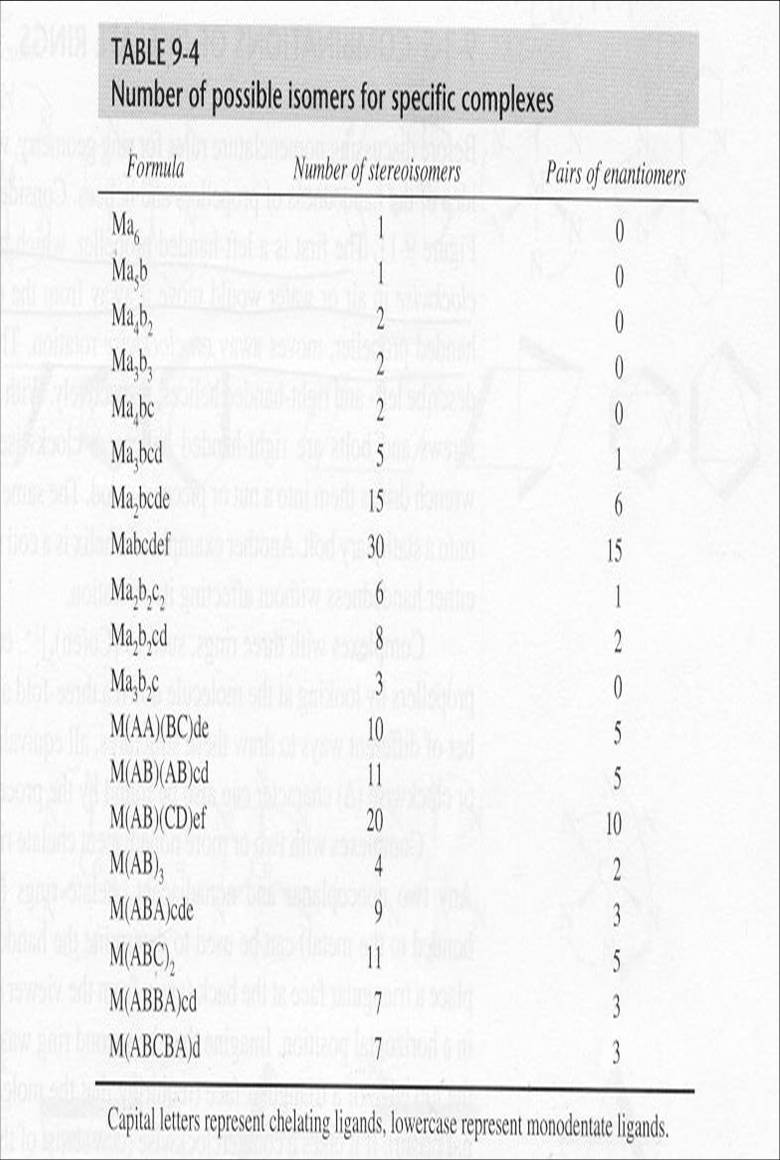
 배위화합물 이성질체 개수 따지기.pdf

피드 구독하기:
글 (Atom)