2012년 12월 22일 토요일

Reduction of nitrobenzene


Reduction of nitrobenzene
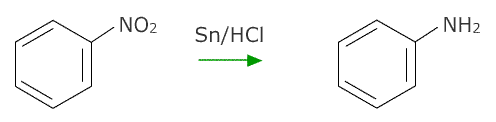
The nitro group is easily reduced by a mixture of tin and hydrochloric acid
The product, phenylamine, also called aminobenzene or aniline, is an important intermediate in the production of azo dyes.
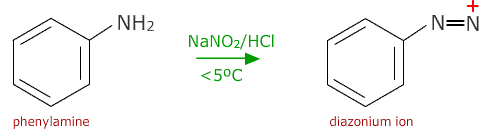
The first stage is to produce a diazonium ion intermediate by reacting phenylamine with nitrous acid below 5ºC
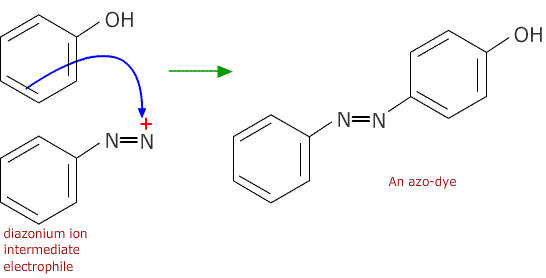
The second stage is reaction of the diazonium ion with a phenol to make the azo dye:

Toluene to Benzoic Acid


Oxidize Toluene to Prepare Benzoic Acid

Toluene to Benzoic Acid – Image by Author.
Benzoic acid has the chemical formula C₆H₅COOH. Its basic structure consists of a benzene ring, C₆H₆, with one of its hydrogen atoms replaced by a carboxyl group (-COOH). There are assorted ways in which benzoic acid can be produced. One popular method is by the simple oxidation of toluene.
Historic Preparation
The concept of producing benzoic acid from alkylbenzenes is not new. Evidence of that is the freely downloadable 1919 thesis publication, “Preparation of Benzoic Acid by Oxidation of Toluol,” by D.W. Grigsby and E.E. McClung.¹
Starting Materials
Although not limited to the production of simple benzoic acid, that example well illustrates the simplicity of the oxidation of alkyl side-chains to produce carboxylic acids. The starting material in this instance is the readily available methylbenzene, or toluene, C₆H₅CH₃. The methyl group (-CH₃) portion of the molecule, only, is converted by oxidation; the aromatic ring remains unscathed.
The basic reaction is:
2 (-CH₃) + 3 O₂ —> 2 (-COOH) + 2 H₂O
The source of oxidation in the laboratory may be dichromate or permanganate, coupling these salts with sulfuric acid. Industrially, oxygen is more often used—in conjunction with a heavy metal based catalyst. The co-product of the reaction is water, removed by simple drying.
Benefits of the Alkylbenzene Oxidation Technique
Chemical reactions involving organic compounds rarely produce a yield of 100 percent. It is far more typical to obtain yields of 95 percent and less. Frequently yields may dip considerably below 90 percent. Also, reaction conditions may be very complicated, and sometimes even dangerous. Side-reactions may contaminate the yield, forcing the need of a very expensive purification. Contrast this with the production of benzoic acid:
  • There is only a single, uncomplicated step.
  • Raw materials are readily available and inexpensive.
  • The process is efficient; the yield is high.
  • Co-product presents little difficulty.
  • Solvents used are recoverable.
Applications
Benzoic acid is widely used as a fungi-static preservative by the food industry, sometimes in the form of the sodium salt. It is also used industrially in plasticizers, such as diethylene glycol dibenzoate, dipropylene glycol dibenzoate, and 1,6-hexanediol benzoate. Benzoic acid is also used in perfumes and flavorings.
¹ Toluol: an old name for toluene
References and Resources:
Originally published by Vincent Summers on June 6, 2011 on the Yahoo! Contributor Network under the title, Preparation of Benzoic Acid, by the Oxidation of Toluene. (28)

2012년 12월 21일 금요일

chiral center


Asymmetric Carbons, Chirality Centers, and Stereocenters
Not only can objects be chiral, molecules can be chiral, too. The feature that most often is the cause of chirality in a molecule is an asymmetric carbon. (Other features that cause chirality are relatively uncommon and are beyond the scope of this book. You can, however, see one of these in Problem 88.)
an asymmetric carbon causes chirality
An asymmetric carbon is a carbon atom that is bonded to four different groups. The asymmetric carbon in each of the following compounds is indicated by an asterisk. For example, the starred carbon in 4-octanol is an asymmetric carbon because it is bonded to four different groups (H, OH, CH2CH2CH3 , and CH2CH2CH2CH3). Notice that the difference in the groups bonded to the asymmetric carbon is not necessarily right next to the asymmetric carbon. For example, the propyl and butyl groups are different even though the point at which they differ is somewhat removed from the asymmetric carbon. The starred carbon in 2,4-dimethylhexane is an asymmetric carbon because it is bonded to four different groups—methyl, ethyl, isobutyl, and hydrogen.
asymmetric carbon in the compounds
Notice that the only carbons that can be asymmetric carbons are sp3 hybridized carbons; sp2 and sp hybridized carbons cannot be asymmetric carbons because they cannot have four groups attached to them.
An asymmetric carbon is also known as a chirality center. We will see that atoms other than carbon, such as nitrogen and phosphorus, can be chirality centers—when they are bonded to four different atoms or groups (Section 5.17). In other words, an asymmetric carbon is just one kind of chirality center. A chirality center also belongs to a broader group known as stereocenters. Stereocenters will be defined in Section 5.5.
which compound have asymmetric carbon

SN2

SN2 Mechanism

Overview:
The general form of the SN2 mechanism is as follows:


nuc: = nucleophile
X = leaving group (usually halide or tosylate)

The SN2 reaction involves displacement of a leaving group (usually a halide or a tosylate), by a nucleophile. This reaction works the best with methyl and primary halides because bulky alkyl groups block the backside attack of the nucleophile, but the reaction does work with secondary halides (although it is usually accompanied by elimination), and will not react at all with tertiary halides. In the following example, the hydroxide ion is acting as the nucleophile and bromine is the leaving group:
Sn2 Mechanism
Because of the backside attack of the nucleophile, inversion of configuration occurs.
Sn2 Mechanism Example
Solvents: Protic solvents such as water and alcohols stabilize the nucleophile so much that it won't react. Therefore, a good polar aprotic solvent is required such as ethers and ketones and halogenated hydrocarbons.
Nucleophiles: A good nucleophile is required since it is involved in the rate-determining step.
Leaving groups: A good leaving group is required, such as a halide or a tosylate, since it is involved in the rate-determining step.

cyclic ketone


  • - Acid catalysed enolization

2012년 12월 20일 목요일

alanine ester


L-Alanine, N-acetyl-, 1-methyl-2-(methylamino)-2-oxoethyl ester, (S)-

상품명칭:L-Alanine, N-acetyl-, 1-methyl-2-(methylamino)-2-oxoethyl ester, (S)-
CAS 레지스트리 번호:32991-01-8
분자 구조:
분자식:C9H16N2O4

Aldol Condensation Mechanism


Aldol Condensation Mechanism

Anonymous
Answered »
4 stars
Can someone write out the mechanism aldol condensation forthis reaction.
    
     
the equation is Benzil + Dibenzyl Ketone ->1,2,3,4-Tetraphenylcyclopentadienone + 2 H2O